Author Interview
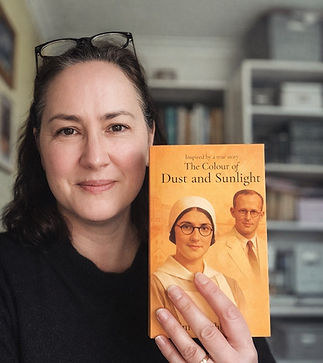
The Colour of Dust and Sunlight
Tell us about your grandmother – who was she?
As grandchildren, we knew her as calm, capable and very composed. What I didn’t realise until much later was how much she had lived through. She was quietly resilient. Not dramatic. Just steady. And I think that steadiness came from the storms she’d already weathered. She was very switched on.
Tell us about your grandfather too?
My grandfather was a warm, jolly character - the kind of person who made you feel at ease straight away. He was also highly intelligent, though that wasn’t something he ever made a show of. Growing up, I had no idea he spoke so many languages. It was only later I discovered he was fluent in Hindi, Urdu and Bengali, and had some Persian too. What I remember most is how gentle and thoughtful he was. When we visited, he would always bring out stacks of paper for us to draw and write on - small things, but they stayed with me. Sadly, he developed motor neurone disease later in life. In the end, he was unable to speak and was confined to a wheelchair. It was incredibly difficult to watch, especially because you could see he still understood everything but found it difficult to communicate. That contrast between the vibrant, capable man he had been and what he went through has stayed with me.
What made you start digging into your grandmother’s story?
It began with a DNA and ancestry membership my stepdaughter Katie gave me for Christmas a few years ago. I started exploring records out of curiosity and quickly realised I didn’t really know my grandparents story at all. As children, we inherit the finished version of people. I wanted to understand my grandma’s story in particular, the young woman she had been before she became our grandmother.
What surprised you most?
The scale of it. She didn’t just move abroad, she rebuilt her life during one of the most turbulent periods in history. Calcutta was bombed. There was political unrest. Supply chains collapsed. Communities were living with constant uncertainty. And yet she carried on building a life, adapting. I also discovered press clippings showing that my grandfather had immersed himself deeply in Indian culture, becoming fluent in Hindi, Urdu, Bengali and some Persian, something I had never known. He worked for the Baptist Mission Press, which had huge historical significance. It made me realise how much of their lives they kept quietly to themselves.
Did your grandparents talk about India much?
Very little. They never dramatised anything. There were photographs, fragments, small details, but not stories. We played with their carom board growing up without really understanding where it came from, and there was Indian jewellery and furniture around the house. And that silence fascinated me. What did people of that generation carry quietly? What did they choose not to say?
What does your grandmother’s story say to women today?
That resilience doesn’t always look loud or heroic. Sometimes it looks like continuing. Rebuilding. Adapting. She stepped into the unknown, faced upheaval and kept going. I think many women will recognise that pattern in their own lives.
How did writing it affect you personally?
It changed how I saw her. She stopped being just “Grandma” and became a young woman with hopes, fears, heartbreak and courage. It also made me think about identity - how much of who we are is shaped by stories we don’t even realise we’re carrying.
Is the book factual or fictional?
It’s historical fiction inspired by her life. The emotional arc is rooted in truth - the time, places and context are carefully researched, but I’ve imaginatively reconstructed the inner life she never expressed. In many ways, it’s my way of giving her the voice she didn’t use.
Why do you think this story resonates now?
Because we’re living in uncertain times again. Stories of women navigating change, displacement and reinvention feel incredibly relevant. There’s also a growing desire to uncover hidden family histories - especially women’s stories that were never fully told.
What drew you to write this as a novel rather than a biography?
Because the facts only tell you so much. What interested me was how it felt, the emotional landscape of leaving everything behind, of heartbreak, of rebuilding in a completely unfamiliar place. Fiction gave me the freedom to explore the silences.
What kind of research went into the book?
A mix of family records, press cuttings, photographs, a lot of historical research and a lot of piecing things together. I spent a considerable time understanding what life in India would have actually been like at that time from the political climate to the practicalities of daily life. But there are always gaps. And those gaps are where the story lives.
Did you feel a sense of responsibility telling her story?
Yes, but not in a restrictive way. I wasn’t trying to document her life perfectly. I was trying to honour the truth of her experience. That meant being respectful but also brave enough to imagine what she might never have said out loud. The book was initially only ever intended as a gift to my mum and to have as a legacy for my family.
What was the most challenging part of writing this book?
Sitting with the emotional weight of it. There were moments where it stopped feeling like a story and started feeling very real, particularly around loss and displacement. I’d had liked to have found out more about Ernest and what happened to him but I couldn’t find any records on him at all so had to leave the story of him where it was. It’s not just writing events, it’s inhabiting them.
And the most rewarding?
The moment the book came alive on the pages and when my grandma Eluned stopped being someone I was writing about and became someone I understood a lot more. To be honest I wasn’t as close to her as I was to my other grandma and I really regret not having got to have known a lot of her story when she was alive but this gave me an opportunity to sort of put that right. I also found out more information about Dr Medway who hosted their wedding after the book was published which I found fascinating. She helped pioneer domiciliary midwifery services in India, working with traditional village midwifes and encouraging safer practices through cooperation and financial incentives. She set up baby clinics and was a leading force in combining two hospitals. The hospital became a training centre for young Indian women entering nursing with Dorothy involved in much of the teaching. She was also awarded with an MBE a year after returning to England. She lived independently until shortly after her 100th birthday and died peacefully in her sleep on 4 April 2004. You can find out more about her on my instagram account @echarltonauthor.
Do you see yourself in Eluned at all?
Yes in quieter ways. That ability to keep going, to adapt, to carry things without always speaking them out loud. I think writing about her helped me understand parts of myself too.
What do you hope readers take away from the book?
A sense that strength doesn’t always look the way we expect it to. And perhaps a curiosity about the untold stories in their own families.
Do you have any other books in progress?
Yes - I’m currently finishing up a book called The Women’s Late Diagnosis Club, which explores autism in women who are diagnosed later in life, including my own experience. It’s a book I wished I’d had pre-diagnosis.
I’m also developing a couple of separate novels - one is a kind of prequel featuring Ceri and Arnold, but this will be entirely fictional and set in London. I'm also working on a novel which is based on my interail journey when I was 17 so moving through Europe to the places I went but interweaving this with a fictional mystery story as well. I have various other ideas in my notes area of my iphone so who knows what else I will write in the future, it’s just having the time to work on them as I do work full time.
Has writing this book changed how you think about storytelling?
Completely. It’s made me realise how much power there is in the stories that almost get lost, the quiet ones, the ones not written down. Those are often the most powerful of all.
If Eluned could read the book, what would you want her to say?
I think I’d just want her to recognise herself in it and to feel that her story, even the parts she didn’t speak about really mattered.